
HwangYounghyun
황영현
Astronomy & Applied AIYonsei University
Non-spinning (Schwarzschild) black hole · thin disk · no radiative transfer
Skip introScrollMachine-learning and scientific software. Tested first where the answer is known, then computed again another way.
About
Check before you trust. Astronomy taught me that.
I study astronomy at Yonsei University, with a second major in physics and a minor in mathematics.
So before I trust a method, I ask: if I already knew the answer, would it find it? I hid known parameters in 100 simulated supernova light curves and checked that my fitting pipeline found them again, with no bias beyond the noise. A satellite change detector that looked reliable fell from F1 0.92 to 0.72 when I misaligned its two images by just five pixels. Knowing where a model breaks matters to me as much as knowing where it works.
I also put work in front of real users. Workbooks from my English-passage pipeline were used in an academy's classes, and my shift-work sleep planner runs as a public phone web app. I build with AI agents (Claude and Codex): they write and run much of the code; I set the tests, review the output and check every number before it is published.
I am serving in the ROK Army, where I operate a thermal observation device (TOD) and a local air-defense radar. That work is the context for my thermal drone-detection project, which uses only public datasets.
Selected work
9 projects, 8 complete and 1 release candidate. Each one says how it was tested and where its limits are.
 A computed point-mass lens bends a compact Gaussian source into a near-Einstein ring, which separates into two bright images as the source offset increases.
Point-mass thin lens · θE = 1″ · 4″ field · finite Gaussian source; display-stretched intensity.
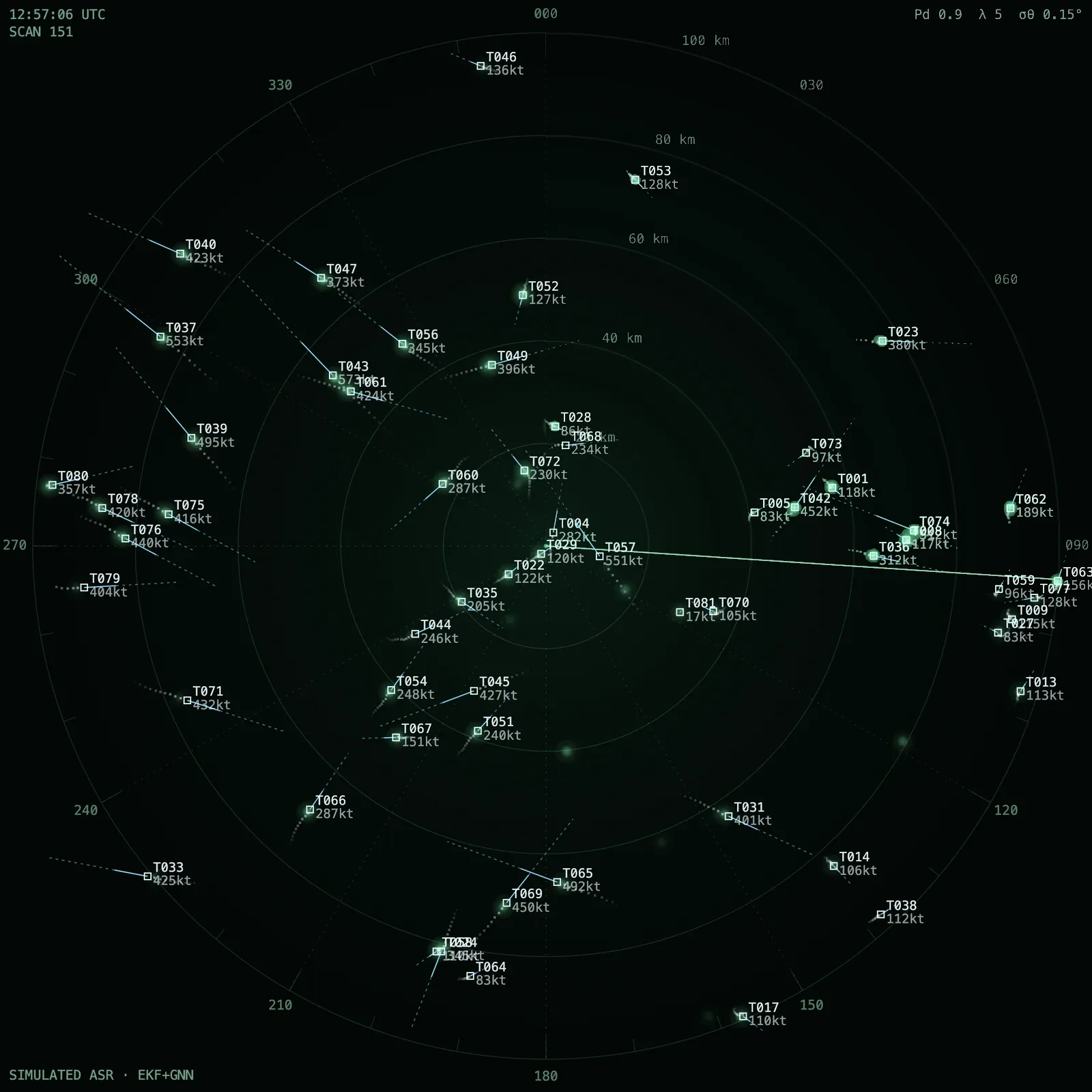
Simulated ASR scope, scan 151 · tracks from the EKF + GNN tracker against public ADS-B truth · the moving scan is a conceptual overlay
Radar Track Lab
Science, multi-target tracking, radar simulation
A radar multi-target tracker (EKF with Hungarian assignment), tested against real aircraft trajectories from public ADS-B data near Amsterdam: position RMSE 175 m against 528 m for a nearest-neighbour baseline, and about 25 identity switches in 30 minutes against 459.
- Simulation study
- Public code
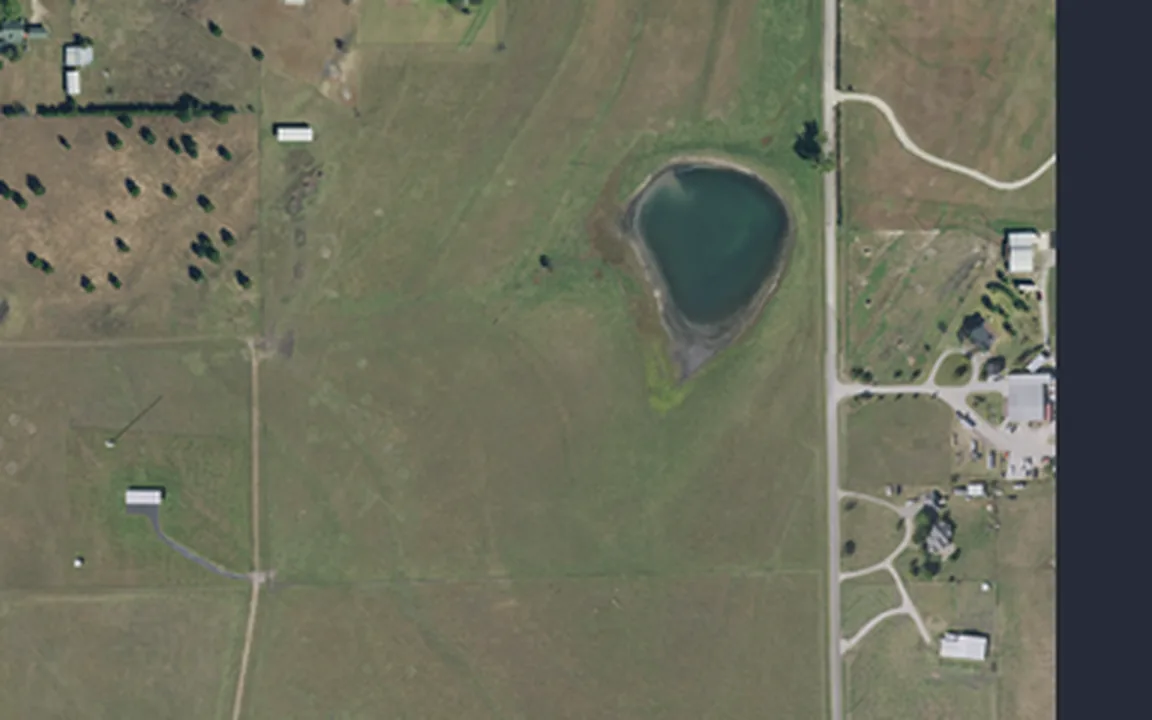
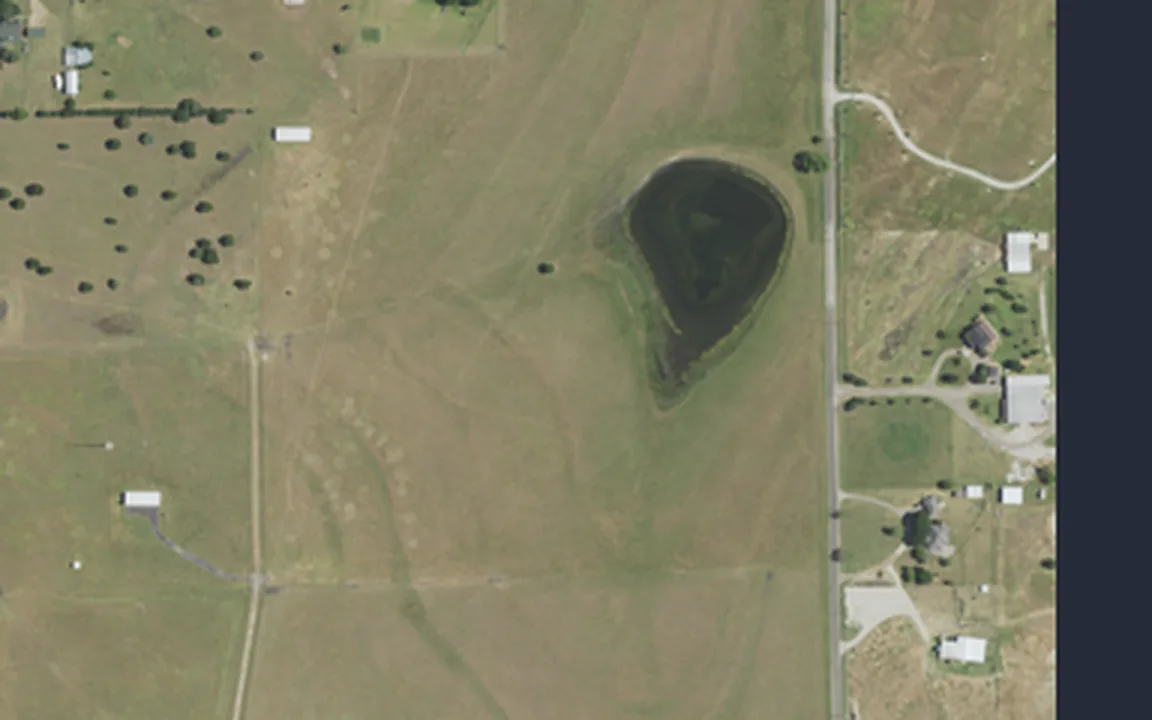
Celina, Texas · NAIP 2020–2022 · 0.6 m/px · TinyCD Original, cutoff 0.5 · qualitative, unscored.
SALT3 fit of the sncosmo example light curve — a simulated Type Ia at z = 0.5, 40 points in g r i z · the catalogue analyses (DES-Dovekie, Pantheon+) are on the case page
Supernova Analyzer
Science, analysis app
Fits supernova light curves with SALT3 and analyses two public catalogues with their full error models.
- Research app
- Public code
Conceptual schematic of the pipeline, not a page of a delivered workbook
Academy Material AI
Apps, LLM pipeline, education
Turns an English passage into a teacher-ready workbook; every LLM output must pass checks against the source first.
- ₩5M investment
- Used in classes
C-major ii–V–I · Dm7 → G7 → Cmaj7 ×2 · both root moves fall by fifths.
Progression Lab
Apps, music theory, optimisation
A browser-only chord-progression analyser that suggests reharmonisations and playable guitar voicings.
- Runs on this site
- Public code
 Short thermal clip from the Anti-UAV300 test set (sequence 20190925_124612_1_4, frames 150–260, every 10th frame): a small drone moves against clouds and the detector's box with its score follows it on each frame.
Anti-UAV300 test · sequence 20190925_124612_1_4, frames 150–260 (every 10th frame, as evaluated) · one detection per frame, scores 0.986–0.999 above the 0.954 threshold, IoU 0.61–0.90 with the labels · full 4-epoch model · one clip, not a performance summary
Thermal Drone Detection
AI, computer vision, thermal infrared
Fine-tunes a Faster R-CNN detector to find small drones in public thermal (IR) video: AP@0.5 0.885 on held-out test videos, against 0.139 for a training-free baseline. On a second public dataset it never saw, recall falls to 48.6%.
- Full 4-epoch run
- Public code
Virtual night-shift demo · 22:00–06:00 recurring shift · planned sleep 06:30–13:30 plus a 20:00–21:30 nap · no personal records.
Shift Sleep Planner
Apps, health tooling, offline PWA
A Korean phone web app that turns a shift roster into sleep, nap and caffeine times, with each rule tied to its source.
- Public web app
- Public code
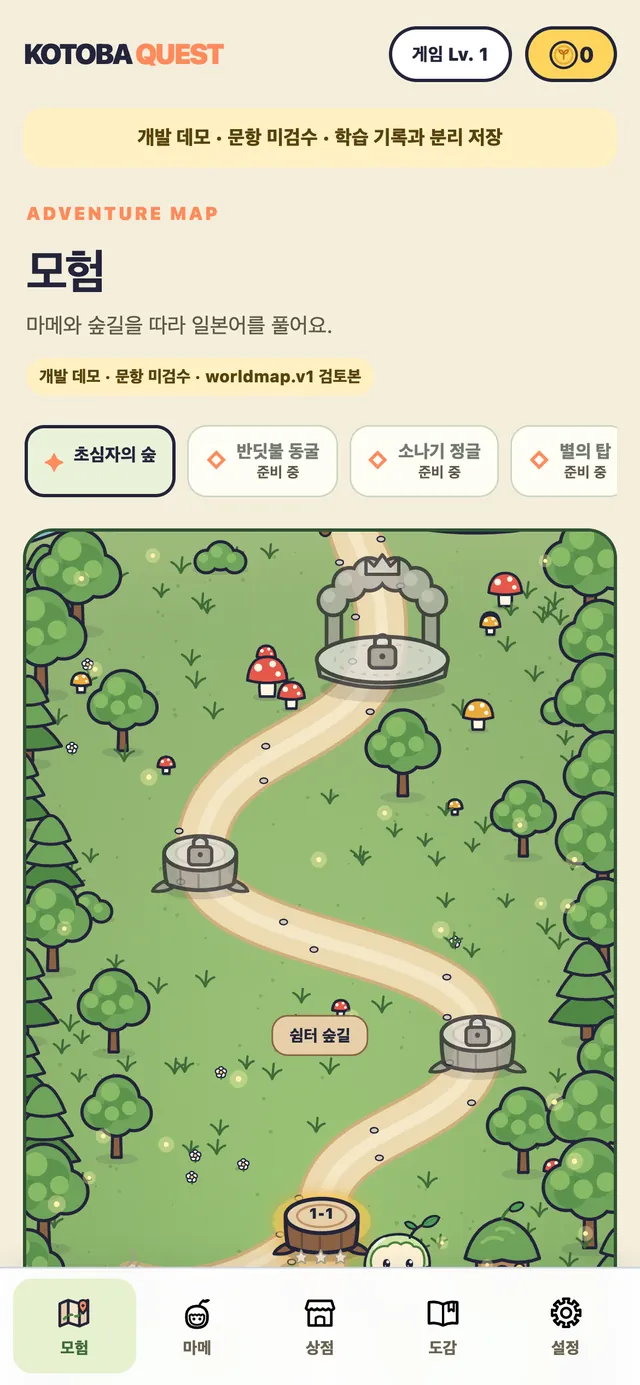

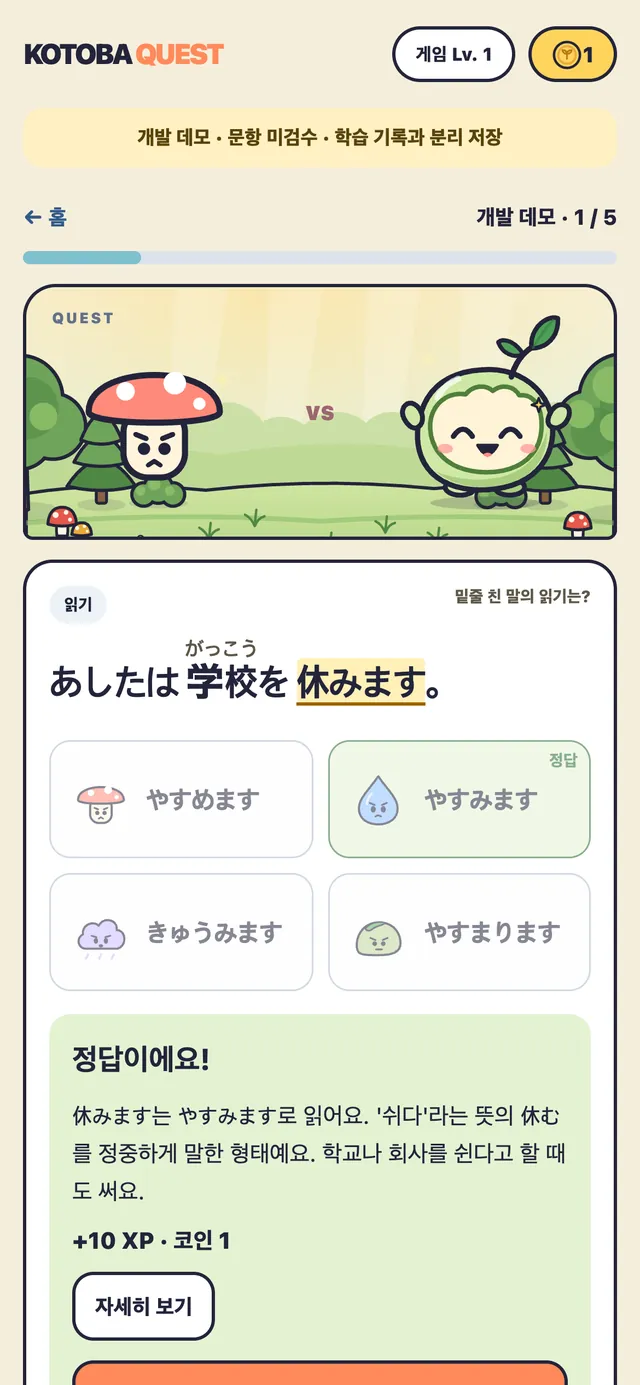

Play sequence of the development build, captured 2026-11-09 in demo mode: world map → question → correct answer → stage reward; each screen carries the demo banner
Kotoba Quest
Apps, language learning, web app
A phone game for learning beginner Japanese words and kanji, with an explanation for every wrong choice.
- Release candidate

Four checks before anything ships.
In the order a result goes through them. Each one is tied to a project where it mattered.
Test where the answer is known
A plausible result is not enough.
Before I trust a method, I run it on a case with a known answer. LensLab's lensed fluxes are compared with a separate source-plane calculation that never calls the model's magnification code. For the point-mass test cases they agree to better than one part in a million, and the same check exposed a faint second image that a coarse grid had missed entirely.
LensLabPoint-mass lens equation, as in LensLab: an extended background source is mapped through the lens; its images form arcs that close into an Einstein ring at alignment. Small circles: the point-source image positions. Recompute it another way
One route is a claim. Two routes are a result.
A result is not done until a second route gives the same number. For Supernova Analyzer, a standalone script recomputed the catalogue statistics from the raw public files without importing the app, and matched every printed digit.
Supernova AnalyzerA Kepler orbit computed two ways: Kepler's equation and a leapfrog integration of the same two-body problem. The bodies stay together; the swept areas per interval are equal. Score on data the model never saw
One dataset is never the whole story.
The thermal drone detector reached AP@0.5 0.885 on held-out test videos, but on a second public dataset it never saw, recall fell from 84.9% to 48.6%, and to 17.6% for drones more than 60 m away. Both results are on the case page.
Thermal Drone DetectionConceptual: points that fit under one condition drift when the condition changes; the held-out group shows how far the fit really holds. Check every output before people use it
Nothing reaches a classroom unchecked.
In the workbook pipeline I built for an English academy, every LLM output must pass rule-based checks against the source text. The 34 delivered PDFs (4,303 pages) were checked page by page and used in classes.
Academy Material AIConceptual: outputs pass through checks in sequence; what fails is set aside, what passes lines up.
Recognition
Awards, funding, admission, mentoring — and the work people actually use.
- AwardGrand PrizeGenAI Competition
- AwardTop TeamAI Startup University
- Investment₩5 million investmentReceived by my AI English workbook project, Academy Material AI
- Selected₩75 million in supportSelected for the 2025 Yonsei Startup Program
- StudyTop-ranked admissionDepartment of Astronomy, Yonsei University, 2023
- MentoringOutstanding MentorJeonju High School Alumni Association (전주고등학교 동창회 최우수 멘토)
In use
- TeachingUsed in real classes80 grammar packs and 34 workbooks (4,303 pages) delivered to an English academy
- ShippedPublic app and codeShift Sleep Planner runs as a public web app; 7 projects have their code on GitHub
Timeline
Study, roles, awards and programmes, by year.
2023
- StudyYonsei UniversityB.S. Astronomy (second major Physics, minor Mathematics); admitted as the top-ranked entrant to the Department of Astronomy.
- RoleLecturer, Children's Astronomy TalksYonsei University Samae Campus Observatory.
- CompletedSpace Center UniversitySpace Center Houston.
2024
- RoleTeaching AssistantGlobal Education Program in NASA.
- RoleUndergraduate ResearcherComputational astrophysics with RAMSES, an adaptive-mesh-refinement simulation code for astrophysical systems.
- ProjectProject-based Contributor株式会社コラボレート研究所 (Japan). Short-term project participation.
2025
- SelectedYonsei Startup ProgramSelected, with ₩75M in support.
- CompletedThe 2nd IBS CTPU-CGA Winter CampInstitute for Basic Science, Center for Theoretical Physics of the Universe (Cosmology, Gravity and Astroparticle Physics).
- CompletedWinter School on Numerical Relativity and Gravitational Waves
2026
- RoleFreelanceAI-generated English workbooks for a Korean academy (paid; used in classes).
- ServiceROK ArmyThermal Observation Device (TOD) and Local Air Defense Radar operations.
- MusicGuitarist, ZINNAlternative rock band.
If it’s about research software, I’m glad to talk.
Reproducibility, scientific analysis, applied AI — or the work above.
dudgus4867@gmail.com